Shopping Cart
Cart items
Shopping Cart
Cart items
Your Wishlist
Wishlist Items
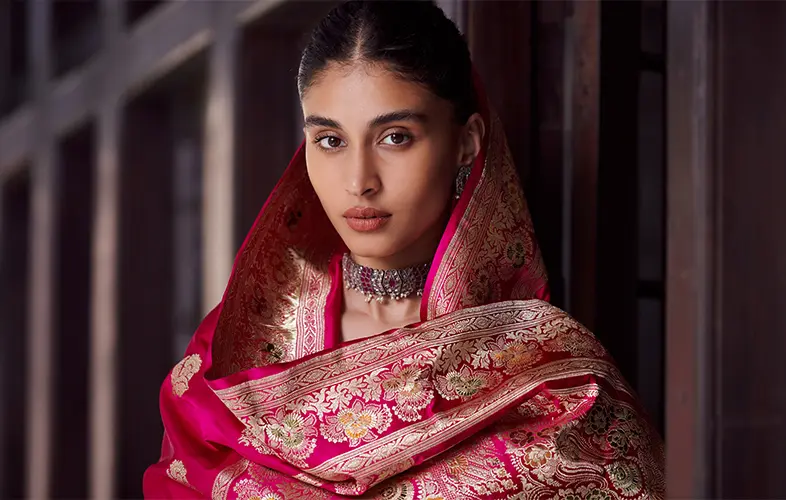
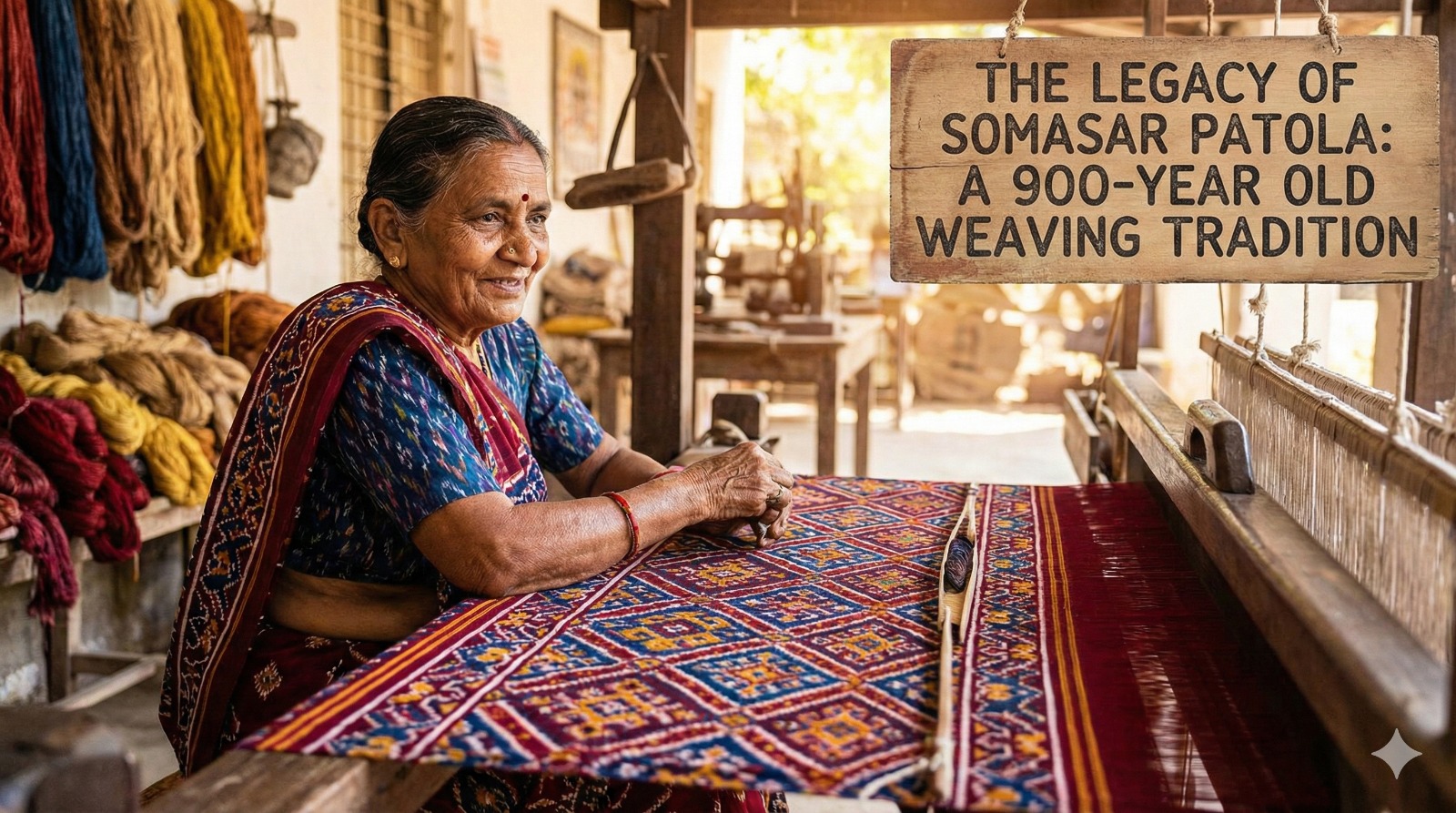
Patola is one of India’s most treasured weaving traditions, admired for its precision, symmetry, and cultural richness. Among the places that continue this ancient craft, Somasar in Gujarat holds a special place. The village has protected the purest form of Patola weaving for nearly nine centuries, passing its knowledge from one generation to the next. At Aadesh Patola, this heritage is not only preserved but celebrated every day through handmade craftsmanship.
The story of Patola began when the skilled Salvi weaving families migrated to Gujarat around the 12th century. Invited by the Solanki kings, they brought with them the art of Double Ikat—an incredibly intricate method of dyeing and weaving that only a few communities in the world could master.
Patola was once woven exclusively for royal families, priests, and wealthy traders. It symbolized purity, prosperity, and status, making it one of the most respected textiles in Indian history.
Unlike most fabrics, Patola designs are not printed or embroidered.
They are dyed into the threads themselves—before the weaving even begins.
This technique, known as Double Ikat, is considered one of the most challenging textile methods in the world. Both the warp and the weft threads are dyed with perfect precision so that the design appears naturally when woven. Even a tiny shift in thread alignment can change the entire pattern, which is why Patola requires months of discipline, planning, and accuracy.
The result is a saree that looks identical on both sides, with colours that remain bright and vibrant for decades.
While Patola is known globally through Patan, the village of Somasar has quietly preserved the most authentic techniques without commercial shortcuts. This village continues to follow the same methods used hundreds of years ago—hand-tying, hand-dyeing, and hand-weaving.
In many families, children grow up watching their parents weave. The rhythm of the loom becomes a part of daily life. The craft is not just a profession here; it is an identity.
Aadesh Patola works closely with these traditional artisans, supporting their livelihood while ensuring that the original art form remains untouched.
Creating a Patola saree is a slow, detailed, and multi-stage process.
Every piece undergoes:
1. Designing the Pattern
Artisans sketch the motifs on graph paper, planning each thread’s placement and each colour transition.
2. Preparing the Silk Threads
The finest silk is stretched, aligned, and divided with extreme accuracy. Every thread must be perfectly smooth.
3. Tying the Threads (Bandhani Style)
Thousands of tiny knots are tied on the threads to block colour during dyeing. This tying process alone can take weeks.
4. Multi-Layer Dyeing
Threads are dyed repeatedly in different colours. After each dye layer, knots are removed and re-tied for the next shade.
5. Aligning Warp & Weft
Once dyed, the threads are carefully arranged on the loom. The final design emerges only when the threads intersect precisely.
6. Hand-Weaving
Two artisans weave together, aligning every thread by hand. The pattern slowly appears on both sides of the fabric, creating the signature mirror-effect of true Patola.
Every step requires patience, skill, and deep experience—no machine can replicate it.
Patola sarees are famous for their meaningful motifs:
These motifs are considered auspicious and are often worn during weddings, festivals, and important ceremonies.
At Aadesh Patola, we believe Patola is more than a textile. It is a heritage that carries stories, emotions, and blessings. Each saree we produce is crafted with the same techniques our ancestors used centuries ago.
We remain committed to:
A genuine Patola can last 40–80 years or more. Many families treat it as a treasured heirloom. Its colours remain rich, its fabric remains strong, and its design remains meaningful long after the saree is woven.
Somasar continues to keep this extraordinary legacy alive, and Aadesh Patola is honoured to be a part of its journey
.jpg)
Double Ikat vs Single Ikat: What Makes Patola Truly Unique?
India’s textile heritage is a treasure trove of intricate designs, age-old techniques, and stories woven into threads. Among these, Patola stands out as one of the most exquisite and complex handloom traditions. Originating from Gujarat, particularly the village of Somasar, Patola is admired worldwide for its vibrant colors, symmetrical patterns, and meticulous craftsmanship. But what makes it truly remarkable is the weaving technique — Double Ikat or Single Ikat. At Aadesh Patola, we preserve and celebrate both forms, ensuring every saree carries the legacy of centuries-old artistry.
Before diving into the differences between Single and Double Ikat, it’s important to understand what Ikat is. Unlike printed or embroidered fabrics, Ikat is a dyeing technique where threads are tied and dyed before the weaving process. This ensures that the design emerges naturally as the fabric is woven, rather than being applied after weaving. The precision, timing, and alignment required in this process make Ikat one of the most sophisticated handloom techniques in the world.
In Patola, Ikat is elevated to perfection, where every thread, color, and motif is carefully calculated. This gives Patola its signature clarity, vibrancy, and long-lasting design.
Single Ikat is the slightly simpler of the two techniques but is by no means easy. In Single Ikat, only the warp threads (vertical threads) are tie-dyed before weaving, while the weft threads remain plain. As weaving progresses, the pattern slowly appears, forming a cohesive and beautiful design.
Single Ikat Patola is admired for:
Single Ikat requires careful alignment, patience, and skilled weaving. The weaver must ensure that every dyed warp thread matches the weaving pattern perfectly, or the design will blur. Even though it is “simpler” than Double Ikat, a single mistake can compromise the entire design.
Double Ikat is considered the most complex weaving technique in the world. Unlike Single Ikat, in Double Ikat, both the warp and weft threads are tie-dyed in precise patterns before weaving. When these threads intersect on the loom, the pattern emerges perfectly on both sides of the fabric, creating a true mirror-image effect.
Double Ikat demands:
Each saree woven using Double Ikat can take anywhere from 6 months to over a year to complete. The precision involved makes it extremely rare and highly valued in the handloom industry.
Patola sarees are not just fabric; they are storytelling canvases. Each motif carries deep cultural and spiritual meaning:
In Single Ikat, these motifs appear mostly on the front side, while Double Ikat ensures full symmetry on both sides, adding to its uniqueness and premium value.
At Aadesh Patola, our artisans carefully preserve these traditional designs, keeping the cultural essence intact while delivering unmatched beauty and craftsmanship.
Creating a Patola saree, whether Single or Double Ikat, is a meticulous and time-intensive process:
Every stage requires patience, precision, and deep knowledge. Any mistake can ruin months of effort, which is why Patola is considered one of the most challenging handloom techniques in the world.
Patola is not only about technique but also about heritage, symbolism, and longevity. What sets it apart is:
Aadesh Patola ensures that every saree we create carries authentic Somasar craftsmanship, blending traditional techniques with modern appreciation.
Single Ikat offers elegance and vibrant design with simpler weaving, while Double Ikat represents the pinnacle of precision, patience, and artistry. Both forms of Patola are treasures of Indian textile heritage, but the unique complexity and mirror-like perfection of Double Ikat make it truly extraordinary.
Every Patola saree from Aadesh Patola is more than just a garment—it is history, culture, and artistry woven into silk, preserving a legacy that has survived for over 900 years. Whether Single or Double Ikat, Patola continues to inspire, captivate, and celebrate India’s rich weaving tradition.
.

The traditional Double Ikat Patola of Somasar has drawn scholarly attention at the international level. Proffessor Wendy Weiss (Univercity of Lincoln ,USA), an independent textile researcher, has documented the weaving traditions, motif philosophy, dyeing techniques, and socio-economic impact of Patola craftsmanship.
Her research, published on ResearchGate, highlights:
- The historical roots of Patola weaving in Somasar
- Technical excellence of double ikat resist dyeing
- Symbolism of traditional motifs
- The role of artisan families in sustaining heritage
This documentation strengthens the academic validation of Somasar’s Patola tradition and reflects the enduring legacy of generational craftsmanship.
The full research paper can be accessed on ResearchGate under the author’s profile.
https://www.researchgate.net/publication/301224393_Finding_Binding_Points_Design_Development_and_the_Digital_World

Somasar’s traditional Double Ikat Patola weaving gained wider public attention when The Better India featured the inspiring journey of Vitthalbhai Vaghela, highlighting his contribution to sustaining and strengthening the Patola tradition in the region.
The video titled “Vitthalbhai Vaghela – The Man Who Revived Patola Art in Somasar and Uplifted His Families” presents his dedication toward preserving the intricate double ikat technique — a process requiring exceptional precision in silk thread tying, resist dyeing, and handloom weaving.
Through years of perseverance, skill, and commitment to tradition, he not only continued the legacy of Patola craftsmanship but also supported artisan families connected to this heritage practice.
The feature by The Better India brings national visibility to Somasar’s weaving community, showcasing how traditional craftsmanship continues to survive in the modern digital era.
The original video can be viewed on the official YouTube Shorts platform of The Better India.
https://www.youtube.com/shorts/FjQGJilhUyo
At Aadesh Patola House, tradition meets excellence. Founded in 1969 in the village of Somasar, Surendranagar, we are dedicated to preserving the sacred art of Patola weaving. Under the guidance of Shri Vitthalbhai Govindbhai Vaghela, every saree we create is a testament to precision, patience, and purity. Our work is handcrafted by skilled artisans, not machines, and each thread carries the legacy of our land and people.