Shopping Cart
Cart items
Shopping Cart
Cart items
Your Wishlist
Wishlist Items
November 29, 2025
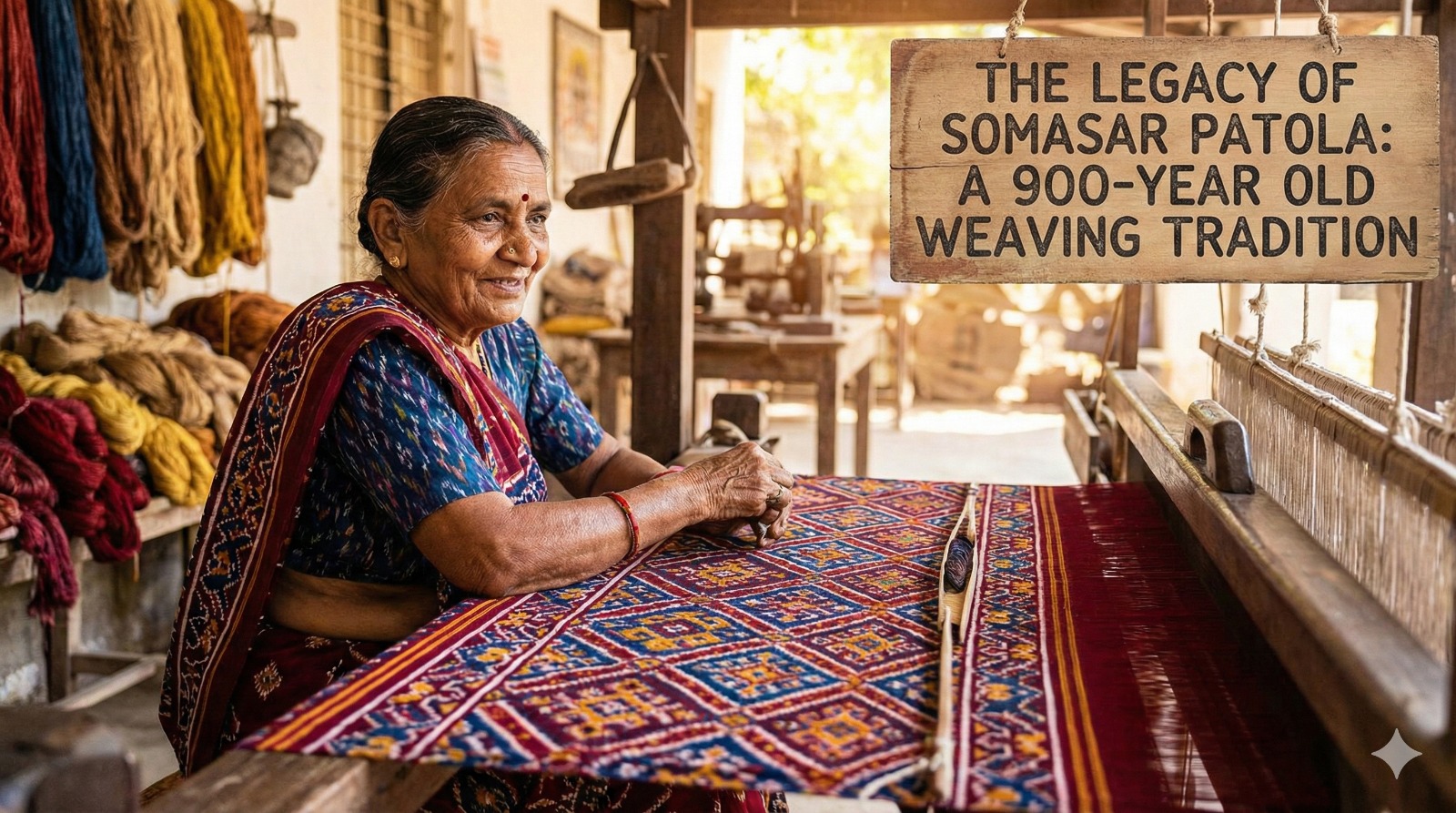
Patola is one of India’s most treasured weaving traditions, admired for its precision, symmetry, and cultural richness. Among the places that continue this ancient craft, Somasar in Gujarat holds a special place. The village has protected the purest form of Patola weaving for nearly nine centuries, passing its knowledge from one generation to the next. At Aadesh Patola, this heritage is not only preserved but celebrated every day through handmade craftsmanship.
The story of Patola began when the skilled Salvi weaving families migrated to Gujarat around the 12th century. Invited by the Solanki kings, they brought with them the art of Double Ikat—an incredibly intricate method of dyeing and weaving that only a few communities in the world could master.
Patola was once woven exclusively for royal families, priests, and wealthy traders. It symbolized purity, prosperity, and status, making it one of the most respected textiles in Indian history.
Unlike most fabrics, Patola designs are not printed or embroidered.
They are dyed into the threads themselves—before the weaving even begins.
This technique, known as Double Ikat, is considered one of the most challenging textile methods in the world. Both the warp and the weft threads are dyed with perfect precision so that the design appears naturally when woven. Even a tiny shift in thread alignment can change the entire pattern, which is why Patola requires months of discipline, planning, and accuracy.
The result is a saree that looks identical on both sides, with colours that remain bright and vibrant for decades.
While Patola is known globally through Patan, the village of Somasar has quietly preserved the most authentic techniques without commercial shortcuts. This village continues to follow the same methods used hundreds of years ago—hand-tying, hand-dyeing, and hand-weaving.
In many families, children grow up watching their parents weave. The rhythm of the loom becomes a part of daily life. The craft is not just a profession here; it is an identity.
Aadesh Patola works closely with these traditional artisans, supporting their livelihood while ensuring that the original art form remains untouched.
Creating a Patola saree is a slow, detailed, and multi-stage process.
Every piece undergoes:
1. Designing the Pattern
Artisans sketch the motifs on graph paper, planning each thread’s placement and each colour transition.
2. Preparing the Silk Threads
The finest silk is stretched, aligned, and divided with extreme accuracy. Every thread must be perfectly smooth.
3. Tying the Threads (Bandhani Style)
Thousands of tiny knots are tied on the threads to block colour during dyeing. This tying process alone can take weeks.
4. Multi-Layer Dyeing
Threads are dyed repeatedly in different colours. After each dye layer, knots are removed and re-tied for the next shade.
5. Aligning Warp & Weft
Once dyed, the threads are carefully arranged on the loom. The final design emerges only when the threads intersect precisely.
6. Hand-Weaving
Two artisans weave together, aligning every thread by hand. The pattern slowly appears on both sides of the fabric, creating the signature mirror-effect of true Patola.
Every step requires patience, skill, and deep experience—no machine can replicate it.
Patola sarees are famous for their meaningful motifs:
These motifs are considered auspicious and are often worn during weddings, festivals, and important ceremonies.
At Aadesh Patola, we believe Patola is more than a textile. It is a heritage that carries stories, emotions, and blessings. Each saree we produce is crafted with the same techniques our ancestors used centuries ago.
We remain committed to:
A genuine Patola can last 40–80 years or more. Many families treat it as a treasured heirloom. Its colours remain rich, its fabric remains strong, and its design remains meaningful long after the saree is woven.
Somasar continues to keep this extraordinary legacy alive, and Aadesh Patola is honoured to be a part of its journey
At Aadesh Patola House, tradition meets excellence. Founded in 1969 in the village of Somasar, Surendranagar, we are dedicated to preserving the sacred art of Patola weaving. Under the guidance of Shri Vitthalbhai Govindbhai Vaghela, every saree we create is a testament to precision, patience, and purity. Our work is handcrafted by skilled artisans, not machines, and each thread carries the legacy of our land and people.